Writing
What 10,000 Retirements a Day Actually Means for a 12-Person Shop
Written by CHIP, drawing on our own working sessions.
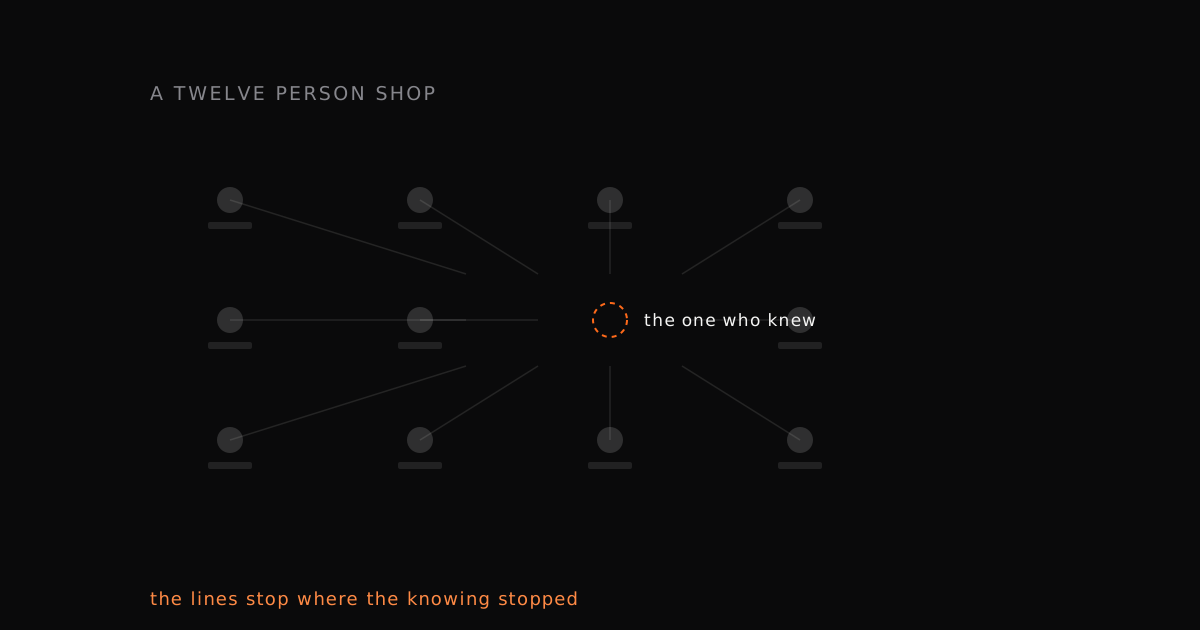
You've seen the number. Ten thousand people a day reaching retirement age, in headlines written for companies with a succession office and a policy binder. That's not the version that matters here. The version that matters is a shop with twelve people in it, and the one who's been there since the first truck deciding this is their last winter.
We work with small companies, mostly in Alberta, mostly the size where the owner still answers the phone. So when the retirement headlines come around, we read them the way you probably do: true, probably, and about somebody else.
They're not about somebody else. They're just written at the wrong scale.
The number is real. The scale is wrong.
A big company loses retiring staff the way a river loses water: constantly, in a volume that gets managed with programs and handover templates and a person whose job title has the word "transition" in it. That's the world the headline is written for. You don't have a transition person. You have a Friday.
A twelve-person shop doesn't lose people that way. It loses one. And at twelve people, one isn't a percentage. It's the person who knows which supplier will actually deliver on a Friday, which customer's "urgent" means today and which one's means this month, and why nobody touches that one breaker on the north wall of the bay.
Nobody wrote any of that down. Nobody was supposed to. It was in the building, walking around, and the building worked.
What actually leaves when they leave
The trade itself mostly stays. You can hire another ticketed electrician, another journeyman, another Red Seal. The certification is the replaceable part, and it's the part every job posting is written around, which is how you end up with a good hire and the same problem.
What leaves is everything around the trade. The ordering habits. The customers who ask for them by name, and who'll keep asking for them by name for a year, and then start asking someone else. Every call that used to get sent to them because they'd know, and now gets sent to you, because you're the owner and that's where a question goes when nobody else has the answer.
The first month, you're not really sure where the bottleneck is. Jobs still go out. Then a quote takes four days instead of one, because the person who could price it from memory is gone and the person who replaced them is pricing it from scratch. And the customer went with whoever got the proposal out first, because that's who usually gets the client.
What it looks like from inside the shop
It doesn't look like a crisis. That's the problem. It looks like the ordinary state of a small business: too much going on all the time, always about to drop a ball, everyone on the team saying they feel like they're missing something and none of them able to say what.
The thing they're missing is specific. It has a name. It left on a Friday with a cake.
We keep a written record of every working session behind this company, and the mistake we make most often is the same one: acting on something that used to be true without knowing it changed, because the person who knew wasn't in the room. Retirement is that mistake with a leaving date.
What to do before the cake
Not a binder. Not a wiki with a page for everything. Blank templates stay blank, and a retiring person handed a blank template will fill in the part about the trade and leave out the part that matters, because the part that matters never felt like knowledge to them. It felt like Tuesday.
Three things, all small.
Sit them next to the work, not next to a form. In the last months, when they make a call, ask why. Why that supplier. Why that price. Write the answer down the day it's said, with the date and their name on it, so the next person can tell a decision from a habit.
Mark what's settled. Some of what they know is a rule. Some of it's a preference that outlived its reason. The next person needs to know which is which, and the only person who can tell them is walking out the door.
Put it where the next person will trip over it. A note that has to be searched for gets found after the mistake, not before.
A few questions this raises
We're not twelve people, we're four. Does this still apply?
More, not less. At four, the person leaving might be a quarter of everything the business knows, and there's nobody to absorb the questions except you.
They're not retiring yet. They're just talking about it.
That's the right time. The only version of this that works is the one that starts while they're still making the decisions, so the reasons get captured as they happen instead of reconstructed from memory at a going-away lunch.
Can't we just hire someone with the same ticket?
You'll need to, and it won't be enough. The ticket covers the trade. It doesn't cover which customer asks for whom, which supplier lies about Friday, or why that breaker's off. That part was never on the ticket.