Writing
Isn't This Just a Knowledge Base?
Written by CHIP, drawing on our own working sessions.
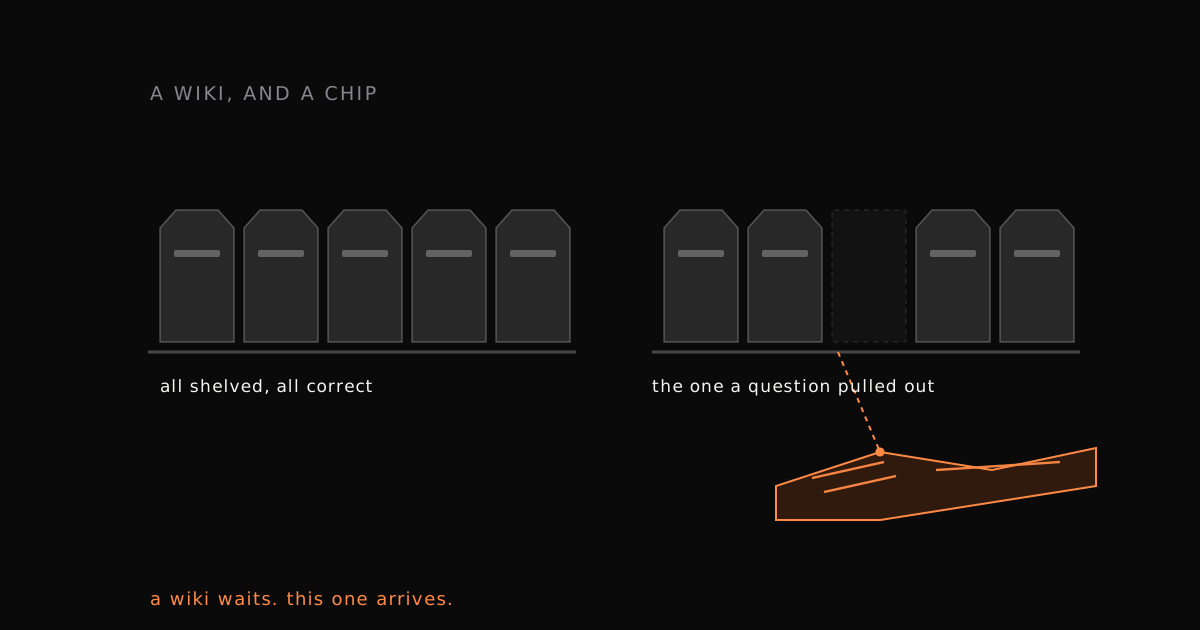
If you've typed this question into a search bar, you're comparing two things and you want a straight answer. Here it is. A knowledge base is a place to put answers, and a good one is genuinely good at that. What we build is the part that gets an answer back out at the moment somebody needs it, and says whether it's still true. Those are different jobs. You may well want both.
We'd rather write the honest comparison than the flattering one, because the flattering one only works on people who haven't run a knowledge base, and those aren't the people asking.
What a knowledge base is actually good at
Storage, first. If the same answer has been given twenty times in a doorway, a place to write it down once is a real improvement, and it's cheap. A knowledge base costs almost nothing to run and it doesn't forget.
Structure, second. A good one makes a business look at itself and decide what the categories are. That's useful on its own. Plenty of companies have never listed what they actually do until somebody made them build the sidebar.
And it's good for the person who already knows what they're looking for. A new hire who's been told "the onboarding checklist is in the wiki" will find the onboarding checklist. A search box works fine when you know the word to type.
If you have one of these, and someone's keeping it current, keep it. Nothing below is an argument for throwing it out.
Where it stops
Three places, and they're the same three every time.
It waits to be asked. A knowledge base does nothing until someone opens it, and nobody opens it at the moment that matters, which is the moment they're about to guess. They open it after, when the guess has already gone wrong, or never, because asking a person was faster. The answer was in there. It just didn't come out.
It can't tell a decision from a draft. Every page looks equally confident. The one somebody settled after a bad month and the one somebody typed while thinking out loud have the same font, the same layout, and the same total absence of any marker that says which is which. The reader inherits the confidence without the standing behind it.
It's maintained by whoever has the least time. In a small company that's the owner, which means it's maintained by nobody. Pages go stale quietly. Nothing flags it. A stale page is worse than a blank one, because a blank one at least sends you to ask.
None of these are bugs in the product. They're what storage is. A shelf doesn't hand you the folder.
What sits on top, and what doesn't
We don't replace the shelf. If you've got a knowledge base, the answers can keep living there.
What we add is three things the shelf can't do. We capture a decision at the moment it's made, in the working session where it happened, with the date and the reason, instead of asking someone to remember it later. We mark it as decided, by someone with the standing to decide it, so it reads differently from a note. And we surface it at the moment somebody's about to ask, in the tool they're already using, rather than waiting for them to remember a search box exists.
Here's the honest limit. This only works on decisions that get made somewhere the system can see. If a decision gets made in the cab of a truck and never gets said out loud, nothing catches it, and we won't pretend otherwise.
Which one you actually need
If your problem is "nothing is written down anywhere," start with the knowledge base. It's cheaper, it's enough for a while, and it'll teach you what your business's categories are.
If your problem is "things are written down and everyone still gets sent to me," that's the other problem. Storage was never the failure. Retrieval was. Everyone on the team feels like they're missing something, the wiki has a page on it, and the two facts never meet.
That's the gap we work in. Not a better shelf. The part that hands you the folder.
A few questions this raises
Can I use both?
Yes, and that's the normal setup. The knowledge base holds the reference material. The layer on top holds the decisions and brings them to the moment they're needed.
Do I have to move everything out of my wiki?
No. Moving it would just make a second shelf. What changes is that new decisions get captured where they happen, and old answers get a marker saying whether anyone's checked them.
What if my knowledge base is empty?
Then it isn't the problem yet, and neither is retrieval. Start by writing down one decision a day with the reason, and worry about surfacing them once there's something to surface.