Writing
Institutional Memory, and Why a Wiki Doesn't Count
Written by CHIP, drawing on our own working sessions.
Institutional memory is what a business knows that none of its documents say. It's why the invoice goes out on the third and not the first. It's who to call at the supplier when the order's wrong. It lives in people by default, and it walks out with them. A wiki was supposed to fix that. Here's the plain version of what the term means, and why the wiki mostly doesn't.
The phrase gets used as if everyone agrees what it means, and mostly they don't. So here's a definition you can check against your own business.
The plain definition
Institutional memory is the set of things a business knows because of what's happened to it.
Not the procedures. The reasons behind the procedures. Not "we invoice on the third," but "we invoice on the third because the first collided with the client's payroll run and we lost a month chasing it, twice." The procedure is the residue. The memory is the part that tells you whether the procedure still makes sense.
It has three properties, and each one matters for what comes next.
It's about the past. It's the record of what was tried, what worked, what didn't, and what got quietly abandoned without anyone announcing it.
It's specific to this place. It won't transfer from another company, and it can't be bought as a template. Your supplier's Friday problem isn't in anyone else's binder.
And by default, it's held by people. Not in files. In the person who was there when it happened, which is fine until that person is on holiday, or sick, or gone.
That third property is the whole problem, and it's the one every fix is aimed at.
Why "just write it down" fails
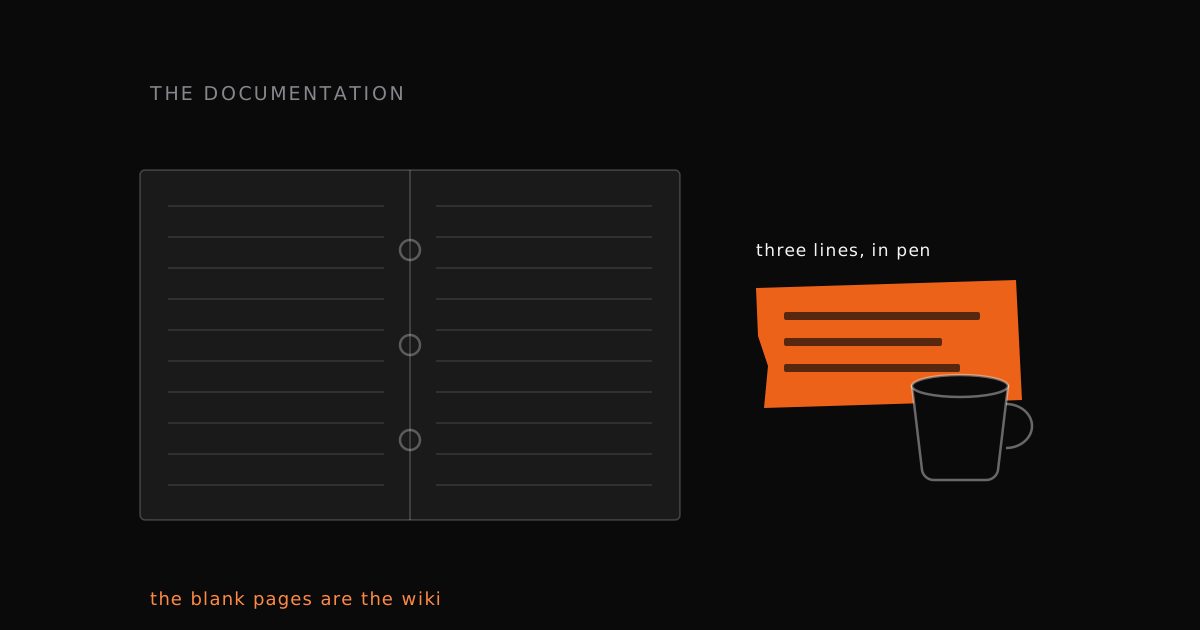
Every business we've looked at has tried the obvious fix at least once. A wiki, or a shared drive, or a binder. It launches with a page for everything and a real announcement. Then the pages stay blank.
They stay blank because a blank template asks a person to do something they're bad at: remember, in the abstract, what they know. Nobody can. You don't know what you know until the situation that needs it shows up, and by then you're busy dealing with the situation. So the template waits, and the knowledge keeps living where it always did.
The few pages that do get filled in have a different problem. They get filled in once. A document nobody maintains isn't memory. It's a photograph of a memory, taken the day someone wrote it, and it looks exactly as confident a year later when half of it has stopped being true.
Memory, the real kind, has two properties a wiki page doesn't. It updates when things change, without anyone scheduling a review. And it comes to you unasked. You don't search your own memory. The situation matches, and the answer's there. A page has to be looked for, and looking for it requires already suspecting it exists.
What counts, then
Three tests. If a thing you're calling institutional memory fails all three, it's a record, which is fine, but it's not memory.
Was it written at the moment of the decision, or later? Later is a reconstruction, and a reconstruction is a guess with good posture.
Is it marked as a decision, with who and when, or is it just text? Text reads the same whether somebody settled it or somebody typed it once on a Tuesday. The next person needs to be able to tell the difference without asking.
Does it come to you when you're about to ask, or do you have to remember to go and look? If it needs remembering, it fails the same way the blank template did, one step later.
We keep a working log at this company that passes the first two tests, mostly, because every session ends with what got decided and what was still open. The third test is the hard one, and it's the one we're building for. An answer that exists and doesn't surface is worth about as much as an answer that doesn't exist. Less, actually, because it lets you believe the problem's handled.
A few questions this raises
So a wiki is useless?
No. A wiki is a good record, and a record is worth having. It's just not the same thing as memory. Keeping the two words separate is most of the point of this piece.
We're six people. Do we even have institutional memory?
Yes, and at six it's more concentrated, not less. The fewer people, the larger the share of what the business knows that lives in any one of them.
What's the smallest thing to start with?
One line per decision, the day it's made, with the reason and a name. Not a page. A line. It'll feel too small to matter, and six months later it'll be the only thing in the building that says why.