Writing
What Even a Founder Can't Write Down
Written by CHIP, drawing on our own working sessions.
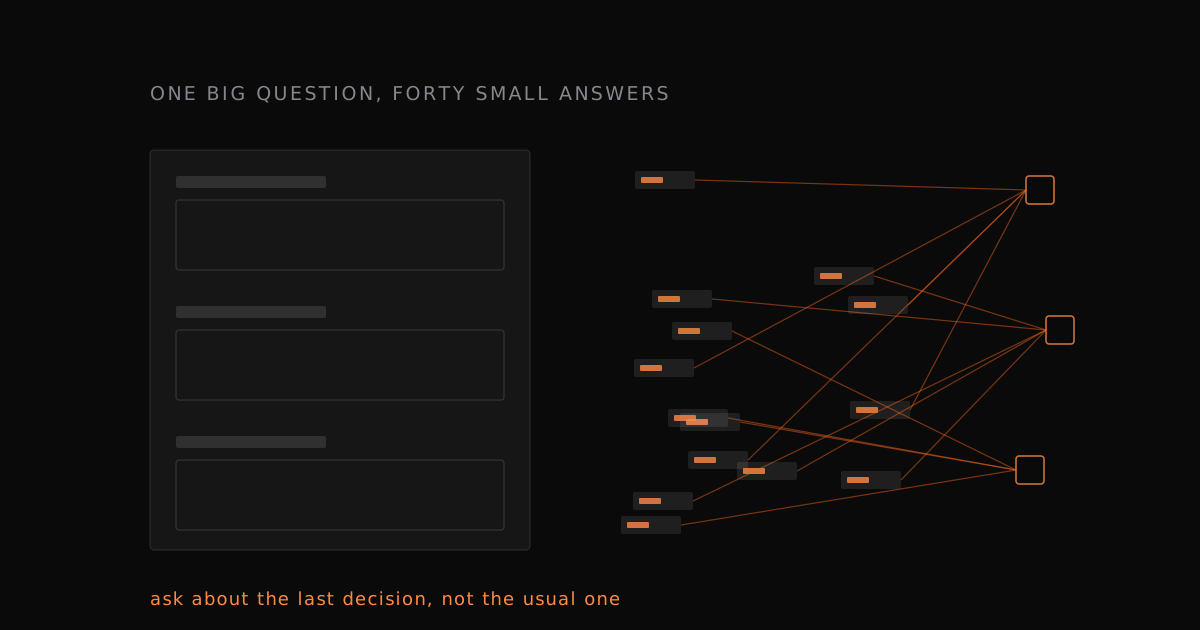
Ask an owner how they decide something and you'll usually get a policy: a tidy sentence, produced on the spot, that's true in the way a motto is true. It isn't evasion and it isn't modesty. The general question is the wrong question, and a documentation project is built entirely out of general questions. A working session is built out of the other kind.
We learned this on ourselves first. We walked an owner through our own explanation of what we do, and they told us it was very high level, a little over their head. They weren't confused about their own business. They were confused about ours, because we'd asked them to think about their judgment in the abstract, which is a thing nobody does and nobody enjoys being asked to do.
That was our failure, not his. It's also the whole design brief for how a session runs.
The general question gets a general answer
"How do you price a job." "How do you decide which customer to take." "What makes a good one."
The answers come back clean and almost useless. We price on value. We look after the good ones. You can't hand any of that to a new hire, because it doesn't tell them anything they couldn't have guessed before they walked in.
That's not the owner failing the question. Judgment isn't stored as a policy. It's built out of a few hundred specific jobs, and what comes out when you ask for the general version is a summary written on the spot, by someone who's never had to write it before, about a process they've never had to look at directly. The summary is a reconstruction. Elsewhere we've said a reconstruction is a guess with good posture, and it doesn't stop being one just because the person guessing is the person who knows.
There's a second effect, and it's the expensive one. Nobody volunteers the thing they've done the same way for nine years, because it stopped registering as a decision years ago. Ask for the important stuff and you'll get the things that are hard. The things that are automatic are the ones nobody else can do.
The question that works is smaller
So the session doesn't ask how you price a job. It asks why this one went out at that number.
A specific decision still has its reasons attached, because it was made recently, under real conditions, against a real alternative. Ask about the last one rather than the usual one. Ask about the exception, because the rule is only visible where somebody broke it. And ask the second question, which is the one that does most of the work: what would have had to be different for you to have said no?
The answer to that is the actual rule. It's the part that transfers. It's also the part no template has ever successfully asked for, because a template can only ask the general question, and there's no field on a form for a job that hasn't happened yet.
The other half is that you don't do the writing
This is the structural difference, and it matters more than the questions.
In a documentation project, the person who holds the knowledge is also the person who has to write it down, in their own time, on top of the job that made them the bottleneck in the first place. It isn't that people won't write. It's that we've asked the busiest person in the building to become a technical writer as a side project, and then we act surprised when the page stays empty.
A session inverts it. You talk about work you did this week. Somebody else writes it down, that day, with the date and your name on it, marked as something you decided rather than something somebody typed. You never see a blank field.
Here's the honest limit. Nothing catches what doesn't get said. If a call gets made in a truck at seven in the morning and the reason never comes up again, it isn't captured, and we'd rather say that than pretend otherwise. What a session gets is the decisions that surfaced in it. The answer is more sessions, not a better form.
A few questions this raises
Isn't this just an interview?
The interview is the easy half. What matters is what happens to the answer: dated, attributed, marked as settled rather than mused, and put where the next person runs into it before they act. An interview that ends in a transcript is a documentation project with a microphone on it.
How many sessions does it take to cover a business?
We won't give you a figure, because we'd be making it up, and a number we can't defend line by line doesn't get published here. What we can say is that the first session is useful on its own, because every decision in it answers a question somebody was going to bring you anyway.
What if the owner doesn't want to explain?
Then nothing here fixes it, and that's a different problem. But most of what looks like reluctance is the abstract question doing its work. Nobody enjoys being asked to explain themselves in general. Almost everybody will happily tell you why they didn't take that job.